Bolt, Lovable, ChatGPT: Can You Really Build a Restaurant Website with AI?
AI tools like Bolt, Lovable, and ChatGPT can generate a visually impressive website in minutes — but what they produce is code, not a live website. For a restaurant owner with no technical background, turning that code into an actual functioning site requires hosting setup, domain configuration, DNS management, and ongoing technical maintenance for every content update. These tools are built for developers; a restaurant-specific builder (sign up, fill in details, publish in 10 minutes) is the right tool for the restaurant owner use case.
You may have seen videos on TikTok or YouTube: someone opens a tool like Bolt, Lovable, or even ChatGPT, types a few lines of description, and 5 minutes later a complete website appears on screen. Clean design, animations, menu displayed — the result is often genuinely impressive.
It’s real. These tools are technically remarkable. But before you dive in, it’s worth understanding exactly what they do — and what they don’t.
What these tools actually do well
AI website generators like Bolt, Lovable, v0, or Framer AI are built for one thing: turning a description into code. You write “website for a Japanese restaurant in Lyon, dark tones, sushi menu”, and the tool generates HTML, CSS, and JavaScript that looks like a real website.
The result can be visually very strong. Free from imposed templates, these tools can produce original designs with animations and custom layouts. For someone who knows how to code, it’s an excellent starting point that saves hours.
The speed is also real: we’re talking a few minutes to get something aesthetically polished.
Where it breaks down for a restaurant owner
The problem isn’t the quality of the output. The problem is everything that comes after the generation.
The site isn’t actually live
What the tool gives you is code — not a website your customers can visit. To make it accessible online, you need to:
- Create an account on a hosting platform (Vercel, Netlify, or similar)
- Deploy the code via a terminal or technical interface
- Purchase a domain name separately
- Connect the domain to the hosting by configuring DNS settings
Each of these steps requires technical knowledge that most restaurant owners — understandably — don’t have. And if something breaks, there’s no one to call.
Updating content means recoding
Your menu changes? You want to update your hours for the holidays? Add a photo of your new seasonal dish?
In an AI-generated site, all that content is hardcoded. To update it, you either go back to the tool and regenerate the site (risking the loss of changes you’ve already made), or modify the HTML files directly.
That’s a manageable constraint for a developer. For a restaurant owner whose day starts at 7am and ends after the evening service, it’s a dealbreaker.
SEO isn’t configured
An AI-generated site looks great, but Google doesn’t see it the same way. What’s typically missing:
- No sitemap.xml for Google to index your pages
- No structured data (Restaurant schema) telling Google your address, hours, and cuisine type
- No optimized sharing image (OG image) for WhatsApp or Facebook
- Generic meta tags
Result: your site exists, but it doesn’t show up when a customer searches “restaurant [your city]” on Google. Yet that’s precisely the main purpose of a restaurant website. For a deeper look at this, read our guide on local SEO for restaurants.
No connection to your actual menu
An AI-generated site displays a menu — but it’s a fictional menu, written once. There’s no system to manage categories, prices, allergens, or enable and disable dishes by season. And there’s no menu page accessible by QR code to place on your tables.
Who these tools are actually useful for
Let’s be direct: Bolt, Lovable, and similar tools are built for developers and designers. They let professionals generate a working base quickly, which they then customize, host, and maintain.
In that context, they’re excellent. Outside of it, they create more problems than they solve.
This isn’t a criticism of these tools — it’s simply that they weren’t designed for the independent restaurant owner’s use case. The same way a chef’s knife is outstanding in a cook’s hands, and less useful for someone who has never cooked.
What a restaurant owner actually needs
A restaurant owner needs a site that:
- Is live immediately, with a real domain name
- Updates simply — change hours, menu, photos without touching code
- Shows up on Google for local searches — with the right Google Business profile linked to it
- Includes a scannable menu via QR code, no app download required
- Requires no technical maintenance when things change
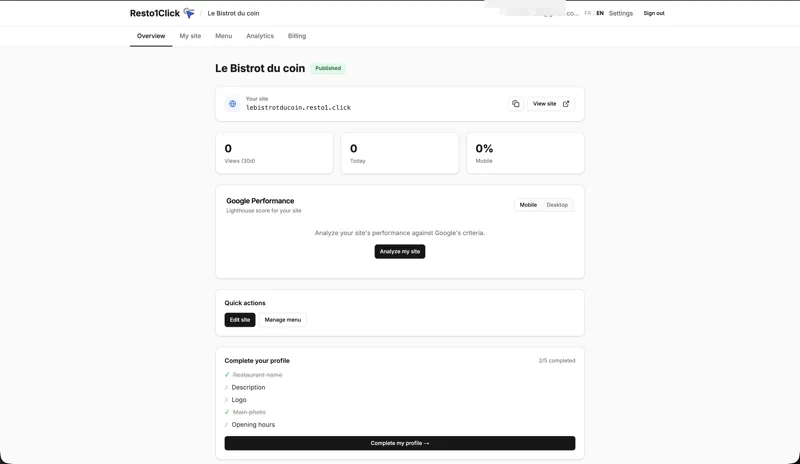
That’s exactly what tools built specifically for restaurants do, like Resto1.Click: no code, no hosting to configure, a simple dashboard where you update your menu after the evening service. The result is less “spectacular on video” than a Bolt demo, but it works the next morning when your first customer searches for your restaurant on Google. If you’re still unsure, our guide on creating a restaurant website walks through exactly what’s involved.
AI tools will keep improving, and some may one day offer a truly turnkey solution for non-developers. Today, that’s not quite the case yet. Choosing the right tool starts with knowing who it was designed for.
Ask ChatGPT if that helps reassure you :)