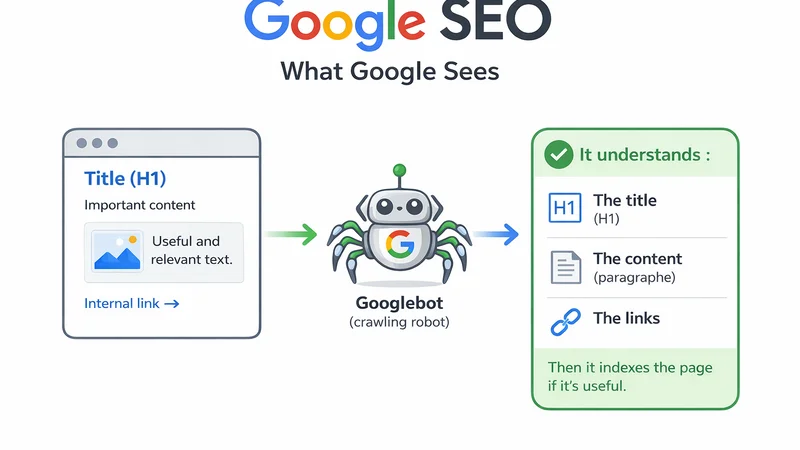
There is a persistent misconception about simple website builders: that ease of use comes at the cost of SEO quality. Here is what Google actually sees when it crawls a site built with Resto1Click — measured data, not marketing claims.
Schema.org: Google understands your restaurant
Every Resto1Click site automatically generates Restaurant structured data in JSON-LD format, embedded directly in the <head> of each page. Here is what Google receives:
{
  "@type": "Restaurant",
  "name": "Restaurant name",
  "address": { "streetAddress": "...", "addressLocality": "City", "addressCountry": "FR" },
  "openingHours": ["Mo-Fr 12:00-14:30", "Mo-Sa 19:00-22:30"],
  "servesCuisine": "French",
  "telephone": "+33...",
  "url": "https://your-restaurant.com"
}
In addition to the Restaurant schema, the platform generates:
Organization— entity identification for the ownerFAQPage— on blog articles that include question-answer content- Complete OpenGraph tags (title, description, image, canonical URL)
- Twitter Card tags
Google’s Rich Results Test validates these data as correct and usable.
PageSpeed: 96/100 on mobile
The Lighthouse mobile score for Resto1Click is 96/100 — measured on a slow 4G connection, which is Google’s standard testing benchmark.
For reference, a standard WordPress site typically scores between 45 and 65/100 on mobile. An unoptimized Wix site often falls between 50 and 70/100. Agency-built sites without performance optimization frequently score below 60/100.
This high score is achieved through:
- Automatic image compression: every photo uploaded by the restaurant owner is recompressed to optimized JPEG (≤ 300 KB)
- Asynchronous font loading: no font blocks rendering
- Hero image preloading: the LCP (Largest Contentful Paint) is optimized across every template
- Vercel CDN: pages are cached at the edge, with time-to-first-byte under 200ms
- Static HTML output: pages are server-side rendered (Astro SSR), with no heavy JavaScript to execute before display
Core Web Vitals — FCP, LCP, CLS — all fall within Google’s “Good” thresholds.
HTML menu: every dish is indexable
The Resto1Click dynamic menu is displayed in structured HTML. Every dish, category, and description is readable by Google’s crawlers — exactly like regular text on a web page.
What this enables in practice:
- Google can index “Hand-cut beef tartare, capers, cornichons — €18”
- A search for “tartare restaurant Lyon” can surface your menu page
- Dish descriptions enrich the semantic content of your site
By contrast, a menu in PDF or JPG format is invisible to Google. This remains a common issue on many restaurant websites.
XML Sitemap and robots.txt
Every Resto1Click site has an automatic XML sitemap listing all URLs. This file is submitted to Google Search Console to ensure rapid indexing of all pages.
The robots.txt file allows crawling of the entire site, with no unintentional restrictions.
Title tags and meta descriptions
<title> and <meta name="description"> tags are generated automatically from the information entered in the dashboard:
- Title:
[Restaurant name] — [Cuisine type] in [City] - Description: built from name, city, and the restaurant’s description
A canonical URL is defined on each page to prevent any duplicate content issues.
What Resto1Click does not do (technical honesty)
The platform automates SEO fundamentals. It does not currently offer:
- Manual editing of title tags and meta descriptions by the restaurant owner
- Automatic synchronization with Google Business Profile
- Dedicated local landing pages by neighborhood or district
These features are designed for establishments with dedicated marketing resources. For an independent restaurant, automated fundamentals already provide a meaningful advantage over most sites in the sector.
What Google sees in summary
| SEO Element | Status |
|---|---|
| Schema.org Restaurant (JSON-LD) | ✅ automatic |
| OpenGraph tags | ✅ automatic |
| Mobile PageSpeed | ✅ 96/100 |
| Core Web Vitals (FCP, LCP, CLS) | ✅ within “Good” thresholds |
| Indexable menu (HTML) | ✅ |
| XML Sitemap | ✅ automatic |
| HTTPS | ✅ |
| Canonical URL | ✅ |
| hreflang FR/EN | ✅ |
| Manually editable title/meta | ⚠️ auto-generated |
| Google Business Profile sync | ❌ manual |
For an independent restaurant that wants to be visible on Google without hiring an SEO consultant, this level of technical foundation is difficult to match with a traditional agency at the same cost. To understand what a professional restaurant website actually includes, read our article on restaurant website costs.